Every B2B buyer asks the same question first: “What should I actually pay?” Whether you’re a distributor quoting a tender, an installer pricing a project, or a brand owner planning your first private-label order, wholesale prices for security cameras can seem opaque — the same 4MP PTZ model can be quoted anywhere from $150 to $400 depending on specs, quantity, and who’s quoting.
This guide breaks down realistic factory-direct wholesale price ranges for the five major camera categories in 2026, the factors that move prices up or down, and how sample pricing, MOQ tiers, and trade terms (EXW/FOB/CIF) work — so you can benchmark any quote within minutes.
Quick Answer: 2026 Wholesale Price Ranges at a Glance
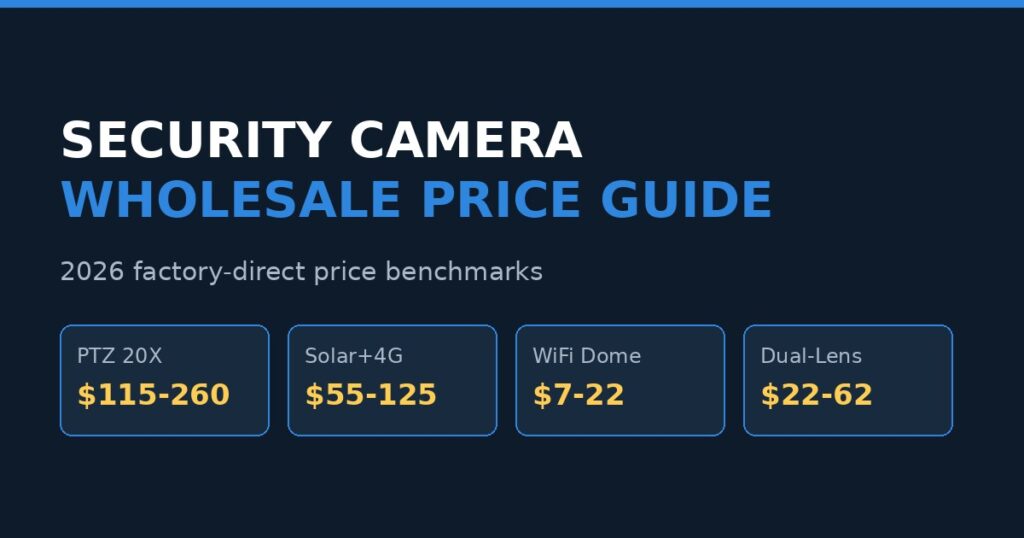
Indicative factory-direct (FOB China) ranges at standard B2B order quantities. Higher-spec configurations push prices toward the top of each range:
| Camera Category | Typical Specs | MOQ 50–200 pcs | MOQ 200–500 pcs | MOQ 500+ pcs |
|---|---|---|---|---|
| PTZ Camera | 4MP–8MP, 20X zoom | $150–260 | $130–220 | $115–190 |
| Long-range PTZ | 4MP, 40X zoom | $480–850 | $430–760 | $390–690 |
| Solar-powered Camera | 4MP, WiFi, 10,000mAh | $55–95 | $48–82 | $42–72 |
| Solar + 4G LTE | 4MP, SIM-based | $70–125 | $62–108 | $55–95 |
| WiFi Dome / Bullet | 2MP–4MP | $9–22 | $8–18 | $7–15 |
| Light Bulb Camera | 2MP–4MP, E27 | $11–26 | $10–22 | $8.5–19 |
| Dual-Lens Camera | 8MP combined, pan+fixed | $28–62 | $25–54 | $22–47 |
Ranges reflect typical factory-direct pricing for mainstream configurations; premium sensors, larger panels, or custom firmware shift quotes upward. Use these as a benchmark, not a floor — quotes far below these ranges usually mean recycled sensors, stripped firmware, or no after-sales support.
Price Breakdown by Camera Type
PTZ Cameras: Optics Set the Price
With PTZ cameras, the zoom lens module is the single biggest cost driver. A 20X optical zoom module alone can account for 30–40% of the BOM. The jump from 20X to 40X typically doubles the price because 40X modules require larger apertures, more precise motors, and better image stabilization. Resolution matters less than you’d expect: moving from 4MP to 8MP usually adds 15–25%, while moving from 20X to 40X zoom can add 80–100%.
Solar Cameras: Battery and Panel Quality Decide Reliability
Solar camera pricing varies with three components: solar panel wattage (5W vs 10W+), battery capacity and chemistry (10,000mAh lithium is standard; cheap versions use half-size cells), and IP rating. A $42 quote and a $72 quote can look identical in photos — the difference is whether it survives a cloudy week in winter. Adding a 4G LTE module (with its modem, SIM slot, and low-power firmware) adds $15–35 depending on the module brand (Quectel and SIMCom are the reliable options).
WiFi Indoor Cameras: The Volume Category
This is the most price-competitive category and the easiest to compare. The main variables are sensor quality (real Sony or OmniVision vs no-name), audio (two-way talk), and pan/tilt mechanics. At 500+ units, expect $7–15 for solid 2MP–4MP units. Watch out for “2K” claims on interpolated sensors — a true 4MP OmniVision sensor at $12 beats a fake 8MP at $10 every time.
Light Bulb Cameras: Small Margins, Fast Turns
Light bulb cameras price like WiFi cameras plus $2–4 for the E27 Edison screw base and internal power supply. Their advantage for resellers is retail-friendly pricing — most consumer listings sit at $25–45, leaving healthy margin on a $10–20 landed cost.
Dual-Lens Cameras: The 2026 Growth Category
Dual-lens (one panoramic + one telephoto) cameras command a premium over single-lens units because they combine two sensors and a stitching SoC. Prices have fallen steadily as adoption grows — configurations that cost $60+ wholesale in 2024 now sit at $28–45. If you’re building a private-label line, this is the category with the most pricing headroom and differentiation potential; see our OEM vs ODM guide for customization economics.
7 Factors That Move Your Quote Up or Down
- Image sensor brand. Sony Starvis and OmniVision sensors carry a 10–20% premium over unbranded sensors — and are worth it for low-light performance claims you can defend.
- AI features. Human/vehicle detection on a dedicated NPU adds $2–8 at BOM level. If a factory quotes AI at a 40% premium, you’re paying for marketing, not silicon.
- IP weather rating. Proper IP66/IP67 sealing (gaskets, glue, test time) adds $3–7 per unit versus indoor-grade housings.
- Optical zoom. As above: the single largest PTZ cost driver.
- Firmware customization. Your logo, boot screen, default app skin, and OTA server usually run $800–2,500 one-time (NRE), amortized across your order.
- Certifications. FCC/CE are usually included; UL, RCMS, or dedicated country marks add per-unit cost for royalty and testing amortization. Our certifications guide maps requirements by market.
- Order size and mix. Factories price total capacity, not just units. One SKU at 1,000 pcs beats five SKUs at 200 pcs each, every time.
Sample Price vs Wholesale Price: How the Ladder Works
Expect to pay 1.3–2× wholesale for samples. This is normal and fair — samples consume production-line time and carry hand-processing costs. Two conventions to know before ordering samples:
- Sample cost is usually refundable — deducted from your first bulk order. Confirm this in writing before paying.
- Order 2–3 samples, not 1. One goes to your bench test, one to your best customer, one stays boxed as a reference for QC disputes later.
A factory that refuses to sell samples at any price, or quotes samples at 5× wholesale, is telling you they don’t want small buyers — useful information early. For a fuller checklist on evaluating suppliers, see how to choose a security camera manufacturer.
EXW, FOB, and CIF: What Your Quote Actually Includes
| Term | Includes | You Arrange | Best For |
|---|---|---|---|
| EXW (Ex Works) | Goods at factory door | Everything: export clearance, freight, insurance | Buyers with their own China forwarder |
| FOB (Free On Board) | Goods + export clearance + loading at port | Ocean/air freight + insurance | Most B2B buyers; the standard benchmark |
| CIF (Cost, Insurance, Freight) | FOB + freight + basic insurance to your port | Import clearance + last-mile | First-time importers wanting fewer moving parts |
Always compare quotes on the same term. An FOB quote of $52 and a CIF quote of $58 to a US port may be identical once you price freight yourself — or not, depending on the factory’s forwarder rates. Ask for both and compare against a spot freight quote.
How to Negotiate Better Prices (Without Sacrificing Quality)
- Negotiate on total order value, not unit price. Adding a second SKU to reach a volume tier often beats squeezing one SKU by 5%.
- Ask what spec change hits your target price. A good factory answers “drop to a 6mm fixed lens and we hit $118” — a bad one just repeats the price.
- Time your order. Chinese factories are most flexible in Q1 (after Chinese New Year, when they’re hungry for orders) and least flexible in Q3–Q4 peak season.
- Pay for quality where buyers see it. Sensor, optics, and weather sealing are visible in reviews. Fancy packaging is not.
- Get the MOQ in writing per SKU, not per order. Mixed-SKU MOQ is standard among flexible manufacturers.
Frequently Asked Questions
What is a realistic MOQ for custom-branded security cameras?
For logo and packaging customization, 100–300 units per SKU is common among flexible manufacturers. Full ODM (custom housing, firmware, app) typically starts at 1,000–3,000 units plus NRE fees.
Are prices lower at trade shows like Canton Fair?
Not really on unit price — but you can negotiate extras: free samples, included certifications, or extended warranty. The real value of shows is meeting factories you can’t find on Alibaba.
How much should shipping add to my landed cost?
By sea, roughly $1.5–4 per camera (LCL to FCL); by air express, $6–12 per unit depending on weight. Solar cameras with large panels cost more to ship relative to their value — factor panels into your freight math.
Do wholesale prices include a warranty?
Standard is 12–24 months with a stated defective rate (usually 0.5–2%). Confirm whether warranty units are replaced free, credited, or discounted — this matters more than the headline percentage.
Get an Exact Quote for Your Order
Ranges get you oriented; only a written quote for your exact configuration and quantity gets you a decision. Send us your target specs and order size — Lensifyr quotes factory-direct PTZ, solar, WiFi, light bulb, and dual-lens cameras with a full spec sheet, typically within 24 hours.